
Check Clarksburg Voter Registration
The Maryland State Board of Elections Voter Lookup is the first stop for a Clarksburg voter checking a personal record. It is an authenticated self-service tool, not a way to browse other residents by surname. The form asks for enough matching data to distinguish the registrant and then uses the residential ZIP and street number held in the voter record. Enter the registered spelling rather than a nickname. The exact fields are unusually important because a correct voter can still receive no match when a recent move or name change has not yet reached the live service.
| Lookup entry | Input | Needed? | Format used by Maryland |
|---|---|---|---|
| First Name | Text | Yes | Registered spelling; letters and spaces |
| Last Name | Text | Yes | Letters, hyphens, and spaces |
| Birth Month | Number | Yes | 1 through 12 |
| Birth Day | Number | Yes | 1 through 31 |
| Birth Year | Number | Yes | Live form validates years 1921 through 2010 |
| ZIP Code | Number | Yes | Five-digit residential ZIP on the registration |
| Street Number | Text | Appears required | Numbers, letters, commas, hyphens, or slashes |
| Middle Initial | Text | No | Use the initial on the registered record |
Use the former ZIP after a move and the former name after a change if the first search fails. Maryland says data updates daily, but a same-day change will not appear. Online and motor-vehicle submissions may take three weeks to process. The state also says a notification card normally takes three to four weeks after an address update. If those checks fail, contact the local board rather than weakening the entries or treating the result as proof that no voter registration exists.
The blank form is visible on the official Maryland voter search screen.
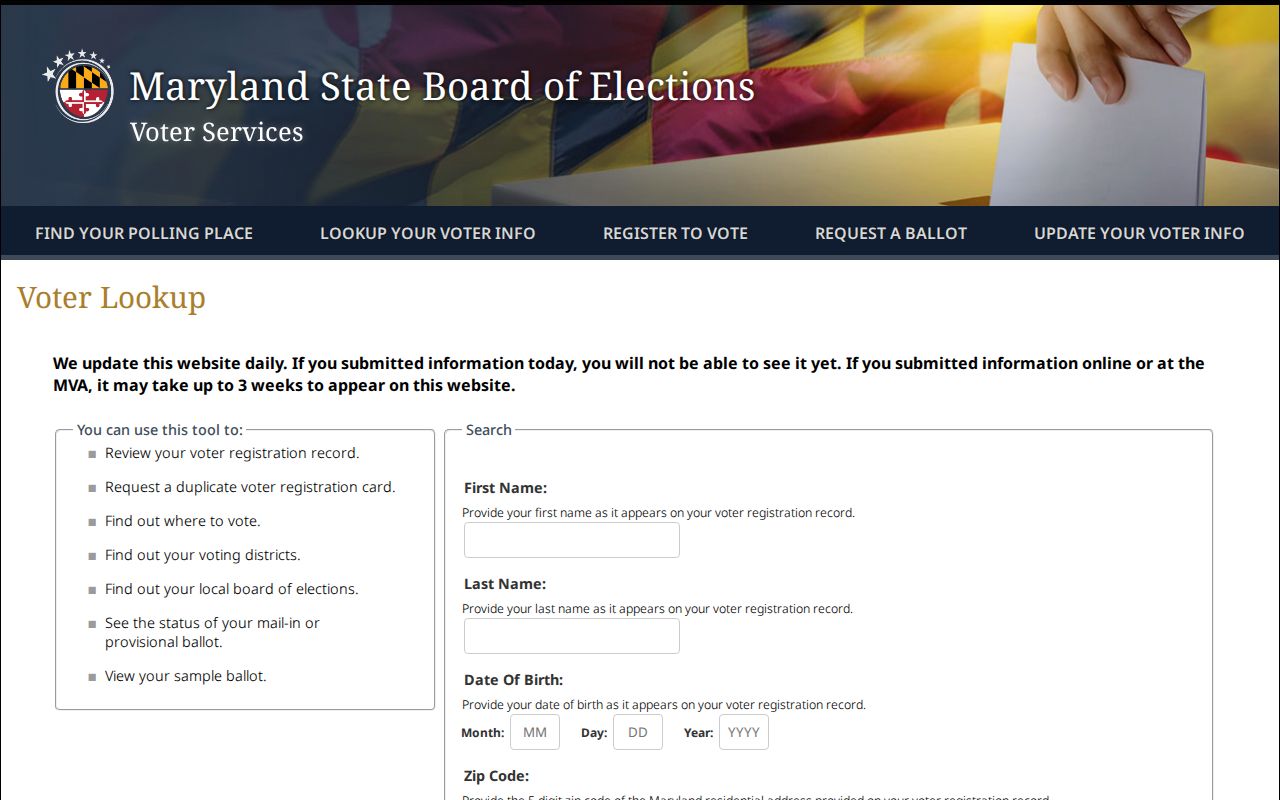
The screen reflects why this service works as a private confirmation tool: several identity and address fields must agree before a record can be returned.
Clarksburg Voter Lookup Results
A successful self-lookup can review the registrant's record and identify the polling place, election districts, and local election board. It can also support a duplicate registration card request. During an election cycle, the service may show a sample ballot and the status of a mail-in or provisional ballot. These functions make the lookup broader than a simple active-or-inactive check, but they remain tied to the person who supplies the matching identity details.
| Registration record | Personal registration details and current status available to the authenticated registrant |
|---|---|
| Polling place | The assigned voting site shown for the address in the record |
| Districts | Election districts that apply to the registered address |
| Local board | The election office responsible for the registration |
| Ballot services | Sample ballot plus mail-in or provisional ballot status when available |
No public post-match sample was inspected because that would require a real voter's identity. The documented functions above come from the state service description. A registration record also does not prove that someone voted in a given contest. Participation history, where lawfully supplied, records an election event and method, never the choices marked on a ballot.
Note: A failed online match is a prompt to check prior registration details or call the board, not evidence of cancellation.
Maryland Voter Records for Clarksburg
Maryland's controlled registered-voter file contains more fields than the self-lookup displays. Its tab-separated rows can include voter ID, name, party, gender, residence and mailing addresses, status, state and county registration dates, precinct, split, county, and several political district fields. Clarksburg is unincorporated, so its voters sit within Montgomery County records rather than a separate city roll. District labels may include congressional, legislative, councilmanic, ward, municipal, or commissioner fields when those fields apply.
- Identity: voter ID, name, party, and gender.
- Address: residence and mailing addresses, subject to protection rules.
- Status and dates: active or inactive status plus state and county registration dates.
- Election geography: precinct, split, county, and applicable district fields.
- Participation: election history that reports participation, not ballot selections.
Confidential by Maryland law. Election Law §§3-202 and 3-506 keep the registration-source office and a decision not to register confidential. The sellable-file inventory excludes a driver or MVA number, partial Social Security number, and full date of birth, while qualifying protected-voter addresses are withheld.
Voting history can be included with a voter list for up to five elections. A separate technical history product can cover up to ten. It may contain voter ID, election date and description, election type and party, method and date of voting, precinct, early-voting location, jurisdiction code, and county. The voter ID joins that history to the main file. Maryland law requires the statewide list to retain at least the prior five years, but none of these fields discloses a voter's selections.
Protected Clarksburg Voter Records
Some residents need a stronger shield than the normal limits on voter registration data. Maryland's Safe at Home Address Confidentiality Program provides a substitute-address system, and protected participants' residence addresses are withheld automatically from voter-list products. A separate election confidentiality form can protect residence address, email, and phone in voter, candidacy, and campaign records for qualifying threatened people and specified officials.
Protection changes more than what appears in a purchased voter roll. A confidential voter cannot use the usual online registration confirmation or ballot-status feature. The person also does not receive the standard pre-election mail-in application and sample ballot. Evidence for confidentiality can include a program or professional statement, a statement describing subjective fear, a qualifying government or court record, or other evidence accepted by the board. The local election office is therefore the right channel for secure status and ballot help.
This boundary is deliberate. Election administration can confirm eligibility and serve the voter without turning a threatened person's home address into a broadly circulated data point.
Request Maryland Voter Rolls
Election Law §3-506 allows a registered Maryland voter to apply for voter data by filing a written request and oath. The applicant selects a region and product, certifies an electoral purpose, chooses delivery, and pays the listed charge. A statewide product costs $125. A single county, Baltimore City, or single district product costs $75. For Clarksburg voter registration data, the county choice is Montgomery County unless a lawful need calls for a broader or district-specific file.
- Use the State Board of Elections registered-voter list request form. Supply the applicant's name, best phone, residential address, city, state, ZIP, and county or city of registration.
- Select the geographic scope and dataset. Optional limits include active voters, registration dates, named parties, or all parties including inactive voters.
- Sign the oath against commercial solicitation and non-electoral use. Choose FTP or email at no delivery charge, or request a flash drive for $1.75.
- Submit payment by an accepted card, check, or money order. Mailing adds $15, and a returned check carries a $30 fee.
The state lists delivery within ten working days after it receives the application and payment. Requests arriving between the 21-day registration deadline and election day are returned. Product choices include a precinct-and-street Walking List PDF, Registered Voter file, Voting History, Permanent Mail-In, election-specific Mail-In, Provisional, Early Voting, and Cure lists. The revised 2025 application makes those newer ballot-process products explicit.
Use is restricted. Maryland bars commercial solicitation and other non-electoral use. Knowing misuse is a misdemeanor; the current form states 30 days to six months, a fine up to $250, or both.
Clarksburg Voter Records Office
The Montgomery County Board of Elections supplies the local service layer for Clarksburg. The office is at 18753 N. Frederick Ave., Suite 210, Gaithersburg, MD 20879. Published weekday hours are 8:30 a.m. to 5 p.m. Call 240-777-8500 or 240-777-VOTE; the fax number is 240-777-8600. Registration mail goes to P.O. Box 4333, Rockville, MD 20849-4333.
Montgomery County Board of Elections
Office: 18753 N. Frederick Ave., Suite 210, Gaithersburg, MD 20879
Phone: 240-777-8500
Hours: Monday through Friday, 8:30 a.m. to 5 p.m.
Registration Mail
Address: P.O. Box 4333, Rockville, MD 20849-4333
Hotline: 240-777-VOTE
Role: Local registration and election assistance
The official Montgomery County elections page brings the county's registration and election services together.
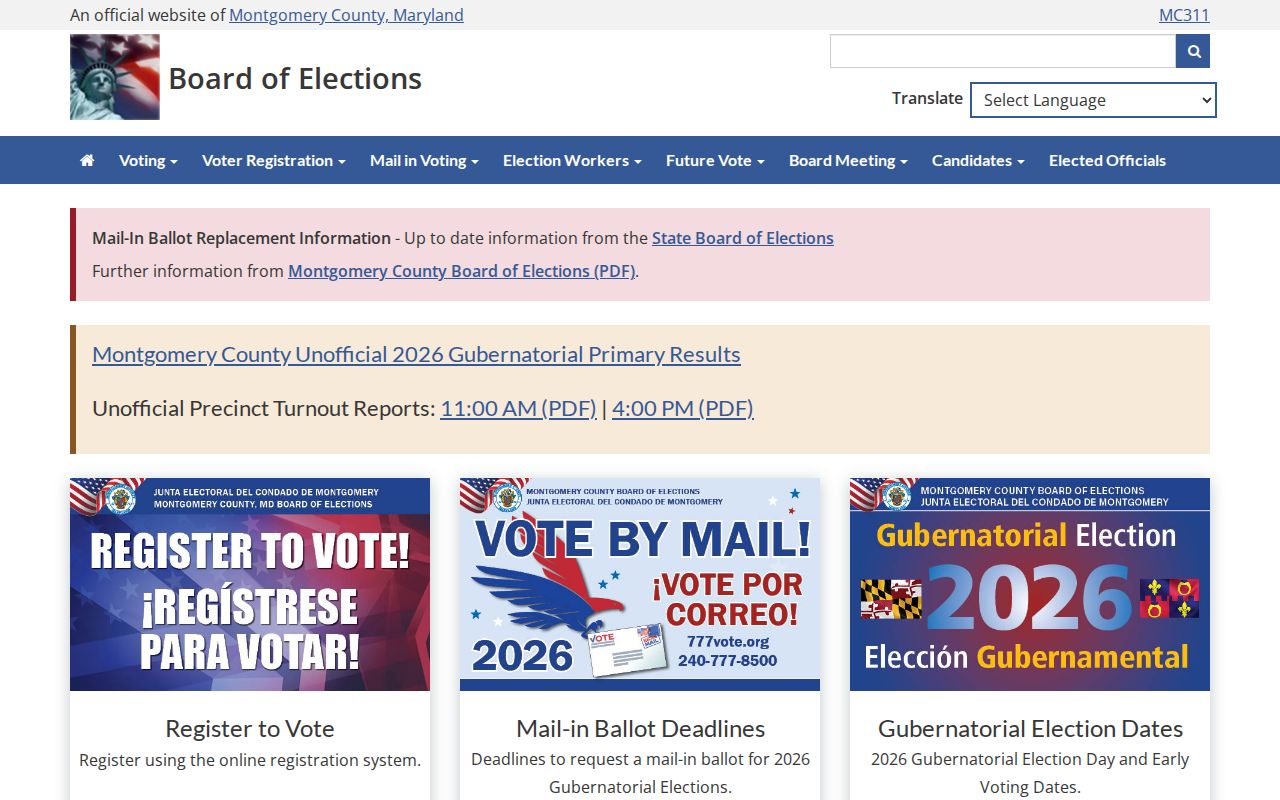
The county page is the practical fallback when a self-lookup fails, a recent update is pending, or a confidential voter cannot use online confirmation.
Note: Clarksburg has no municipal elections office or separate city voter roll; Montgomery County and Maryland are the proper custodians.
Clarksburg Voter Roll Status
An inactive label should not be read as proof that a registration was cancelled. Maryland list maintenance uses several official data streams. Election Law §3-504 covers monthly information on deaths, felony incarceration, name changes, cancellations, approved address changes, and certain condemned or razed residences. Those inputs help election officials maintain voter rolls, but a single status value needs context from the local board.
A recently moved voter may still match under an old ZIP while an address update is being processed. Likewise, the state's three-week processing guidance for some online or motor-vehicle submissions explains why a current change can lag behind the search form. Start with the old and new registration details, note when the change was filed, and contact Montgomery County Elections if the record remains unclear.
Can an inactive record be treated as a cancellation? No. Inactive and cancelled are distinct conditions. Confirm the current registration with the election office before drawing a conclusion from a list field.
Montgomery Voter Records by Numbers
Montgomery County reported 707,821 active registrations in June 2026, plus 56,537 inactive records. The active count comprised 407,996 Democratic, 99,272 Republican, 1,093 Green, 517 Working Class, 189,455 unaffiliated, and 9,488 other registrations. These are county totals, not a Clarksburg-only count, and they should not be used to infer any individual's affiliation or status.
| June 2026 category | Montgomery County count |
|---|---|
| Democratic | 407,996 |
| Republican | 99,272 |
| Green | 1,093 |
| Working Class | 517 |
| Unaffiliated | 189,455 |
| Other | 9,488 |
| Total active | 707,821 |
| Inactive | 56,537 |
The totals give scale to the county file and show why exact identity fields matter. They also illustrate why aggregate election statistics and person-level records answer different questions. The former describe the electorate as a whole. The latter remain subject to identity checks, eligibility rules, confidentiality, and the electoral-purpose oath.
Historic Clarksburg Voter Registers
Current voter registration tools are not the right source for family history. The Maryland State Archives preserves Montgomery County Board of Registry series C3362, titled “Voter Registration Record,” for 1896 through 1936 and 1944. The volumes are arranged by election district, precinct, and surname. That structure can place a named person within an older civic geography, but it requires more care than typing a modern Clarksburg ZIP into a present-day portal.
Montgomery County also has poll books from 1884 through 1895. They are alphabetical within election districts. Pair them with maps and boundary sources from the same era because Clarksburg was a rural crossroads, not an incorporated town with stable municipal borders. Modern subdivision, planning, school, and precinct labels cannot be projected backward without evidence. Montgomery County formed from Frederick County in 1776, so still earlier election or civic trails may sit in Frederick County or provincial series.
Historical voter records document registration or participation within their own period. They do not supply ballot choices, and gaps should not be filled by assumption. Record the series, district, precinct, year, and name spelling with each finding so another researcher can return to the same archival source.